The sky
What you see above the plateau, why the sky here is so dark, and the names shepherds gave the stars.
Pl. 08.1 · 3 min read
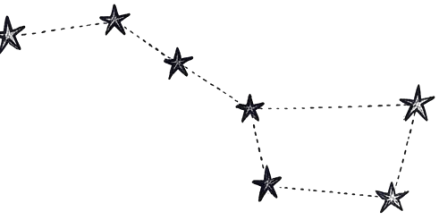
The shepherd's stars
The Way of Saint James, the Chariot of Souls, Jean de Milan, Maguelonne… the sky as told by the shepherd in Alphonse Daudet's "The Stars".
Pl. 08.2 · 2 min read
Why the Haute-Provence sky is so dark
Altitude, dry air, little lighting: why astronomers chose Haute-Provence, and how a planet around another star was discovered there.
Pl. 08.3 · 2 min read
The year's shooting stars
From the Quadrantids in January to the Geminids in December: the main meteor showers, their dates and how to watch them.
Tonight's sky
- Disc lit
- —
- Sunset
- —
- Fully dark from
- —
- Next new moon
- —
Planets tonight
Positions worked out in your browser from the approximate orbital elements published by NASA's JPL, to within a few tenths of a degree.
This month ·
Worked out in your browser for the Sault plateau (44.09° N, 5.41° E), with no external service. Paris time.
The sky, month by month
What you can see from the plateau around 10 pm, with the naked eye, binoculars and a telescope. Planets change from year to year: they are computed live in the "Tonight" panel.
01 January· this month
- Evening constellations
- Orion, Taurus, Gemini, Auriga, Canis Major
- With binoculars
- the Pleiades (M45), the Hyades around Aldebaran, the Orion Nebula (M42)
- Through a telescope
- the Orion Nebula and the Trapezium, the open cluster M35 in Gemini
- Shooting stars
- Quadrantids (3–4 January)
- The shepherd's sky
- The Three Kings (Orion's Belt) chase the Poussinière (the Pleiades), with Jean de Milan (Sirius) close behind. Read →
02 February· this month
- Evening constellations
- Orion, Gemini, Canis Minor, Cancer, Auriga
- With binoculars
- the Beehive Cluster (M44) in Cancer, the clusters M36, M37 and M38 in Auriga
- Through a telescope
- the Orion Nebula, the Auriga clusters
- The shepherd's sky
- Jean de Milan, the "torch of the stars", shines low in the south early in the night. Read →
03 March· this month
- Evening constellations
- Leo, Cancer, Ursa Major, Gemini
- With binoculars
- the Beehive Cluster (M44), Mizar and Alcor in Ursa Major
- Through a telescope
- the galaxies M81 and M82 in Ursa Major
- The shepherd's sky
- The Chariot of Souls (the Great Bear) climbs high above the north-eastern horizon. Read →
04 April· this month
- Evening constellations
- Leo, Boötes, Virgo, Ursa Major
- With binoculars
- Mizar and Alcor, the globular cluster M3, near Arcturus
- Through a telescope
- the galaxies of Virgo and Coma Berenices
- Shooting stars
- Lyrids (around 22 April)
05 May· this month
- Evening constellations
- Boötes, Corona Borealis, Hercules, Virgo
- With binoculars
- the Hercules Cluster (M13), Mizar and Alcor
- Through a telescope
- the Hercules Cluster (M13), the Whirlpool Galaxy (M51)
06 June· this month
- Evening constellations
- Hercules, Lyra, Scorpius, Ophiuchus
- With binoculars
- M13 in Hercules, Antares and the cluster M4 in Scorpius
- Through a telescope
- the "double double" Epsilon Lyrae, the cluster M4
- The shepherd's sky
- The nights are short: full darkness only begins around midnight.
07 July· this month
- Evening constellations
- Cygnus, Lyra, Aquila, Scorpius, Sagittarius
- With binoculars
- the Milky Way in Sagittarius, the Lagoon Nebula (M8), the cluster M22
- Through a telescope
- Albireo, an orange and blue double star, the Lagoon Nebula
- The shepherd's sky
- The Way of Saint James (the Milky Way) crosses the whole sky, from north-east to south. Read →
08 August· this month
- Evening constellations
- Cygnus, Lyra, Aquila, Sagittarius, Cassiopeia
- With binoculars
- the Milky Way in Cygnus, the cluster M22
- Through a telescope
- the Dumbbell Nebula (M27), the Ring Nebula (M57), Albireo
- Shooting stars
- Perseids (12–13 August)
09 September· this month
- Evening constellations
- the Summer Triangle, Pegasus, Andromeda, Cassiopeia
- With binoculars
- the Double Cluster in Perseus, the Andromeda Galaxy (M31), late in the evening
- Through a telescope
- the globular cluster M15 in Pegasus, the Ring Nebula (M57)
10 October· this month
- Evening constellations
- Pegasus, Andromeda, Cassiopeia, Perseus
- With binoculars
- the Andromeda Galaxy (M31), the Double Cluster in Perseus
- Through a telescope
- the Triangulum Galaxy (M33), M31 and its companions
- Shooting stars
- Orionids (around 21 October)
11 November· this month
- Evening constellations
- Andromeda, Perseus, Cassiopeia, Aries, Taurus
- With binoculars
- the Pleiades (M45), the Andromeda Galaxy, the Double Cluster
- Through a telescope
- the Double Cluster in Perseus, the Andromeda Galaxy
- Shooting stars
- Leonids (around 17 November)
- The shepherd's sky
- The Poussinière (the Pleiades) rises in the east early in the evening, first of the winter procession. Read →
12 December· this month
- Evening constellations
- Taurus, Orion, Auriga, Gemini, Perseus
- With binoculars
- the Pleiades, the Hyades, the Orion Nebula, late in the evening
- Through a telescope
- the Orion Nebula, the cluster M35
- Shooting stars
- Geminids (13–14 December)