The shepherd's stars
The Way of Saint James, the Chariot of Souls, Jean de Milan, Maguelonne… the sky as told by the shepherd in Alphonse Daudet's "The Stars".
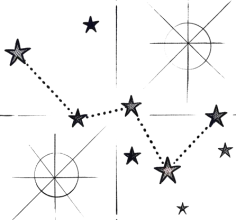
In one of his Letters from My Windmill, Alphonse Daudet gives the floor to a shepherd from the Luberon. One summer night, his masters’ daughter, Stéphanette, is stranded at the pasture by a flooded river. Sitting beside her at the fire, the shepherd names the stars for her. This short story, “Les Étoiles” (“The Stars”), is probably the finest map of the Provençal folk sky you can still read today.
A sky of roads and wagons
The first thing the shepherd points out is the Milky Way, which he calls the Way of Saint James (le Chemin de saint Jacques): it runs “from France straight to Spain”, as if to guide pilgrims to Compostela. The name is not unique to Provence; several southern European languages use it.
Further on comes the Chariot of Souls (le Char des âmes), which Daudet himself identifies as the Great Bear, with its “four shining axles”. The three stars in front are the Three Beasts, and the tiny star tucked against the third one is the Carter. You can easily recognise the handle of the “saucepan” and, beside its middle star, little Alcor, traditionally cited as a test of good eyesight.
The Three Kings and Jean de Milan
Lower in the south, the shepherd shows the Rake or the Three Kings: Daudet explains in brackets that this is Orion, and the three aligned stars of the Belt are clearly meant. Lower still shines Jean de Milan, “the torch of the stars”: Sirius, the brightest star in the night sky.
The shepherd then tells a little story: Jean de Milan, the Three Kings and the Poussinière (the Pleiades) were invited to a wedding. The Poussinière, in a hurry, set off first; the Three Kings took a lower road to catch up; Jean de Milan, who had overslept, threw his stick at them in anger. It is a way of remembering the order in which these stars rise on winter nights: first the Pleiades, then Orion, then Sirius.
Maguelonne, the shepherd’s star
The last star named is the most familiar: the shepherd’s star, which lights the flock at dawn and on the way home in the evening. The shepherd also calls it Maguelonne, after the heroine of a medieval romance, who “runs after Pierre de Provence” and marries him every seven years. Daudet identifies Pierre de Provence with Saturn. The “shepherd’s star” is in fact a planet, Venus, seen sometimes in the evening, sometimes in the morning, never far from the Sun.
Finding them from the plateau
- All year round, the Chariot of Souls circles the Pole Star and never sets at our latitude.
- From October to March, the Poussinière, the Three Kings and then Jean de Milan rise one after another in the east during the evening, in the order of the tale.
- In summer, the Way of Saint James crosses the sky from north-east to south; on a moonless night it is clearly visible to the naked eye from the Sault plateau.
Daudet’s text is in the public domain: it takes ten minutes to read, and is worth rereading with a red torch in your hand.
Sources
- Alphonse Daudet, « Les Étoiles. Récit d'un berger provençal », Lettres de mon moulin — Wikisource
- The Constellations — International Astronomical Union (IAU)