Why the Haute-Provence sky is so dark
Altitude, dry air, little lighting: why astronomers chose Haute-Provence, and how a planet around another star was discovered there.
Driving up towards Sault on a clear night, you quickly understand why astronomers settled in this region. The sky here is darker, starrier and more often clear than in most of France. Several reasons add up.
Little light, plenty of night
The first reason is human: the high plateaus of Provence are thinly populated. Far from large towns, the orange glow of street lighting stays low on the horizon and the sky keeps its depth overhead.
Since a decree of 27 December 2018, outdoor lighting in France must limit the light sent up into the sky: fixtures aimed at the ground, warmer colour temperatures, and for some installations switching off at certain hours. Many rural villages also turn off their street lights in the middle of the night.
Altitude and dry air
The second reason is geographical. Above 700 metres, you leave behind part of the humidity and dust of the low valleys. The air is often dry, and the mistral, which regularly sweeps the Rhône valley, chases the clouds away. On the other hand, when it blows hard, the turbulent air makes images “boil” in a telescope: a very transparent sky is not always a very steady one.
An observatory since 1937
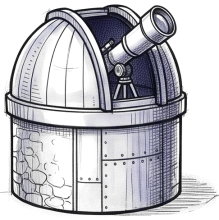
These qualities led to the founding, in 1937, of the Haute-Provence Observatory in Saint-Michel-l’Observatoire, in the Alpes-de-Haute-Provence, about thirty kilometres east of Sault. Today it is run by the CNRS and Aix-Marseille University.
It was there, in 1995, that Michel Mayor and Didier Queloz announced the discovery of 51 Pegasi b, the first planet found orbiting a Sun-like star. They used a spectrograph mounted on the observatory’s 1.93-metre telescope. The discovery earned them the 2019 Nobel Prize in Physics, shared with James Peebles.
What it means for the naked eye
Under a truly dark sky you see several thousand stars with the naked eye, instead of a few dozen in town. The Milky Way becomes a shaded band cut by dark lanes, and in autumn the Andromeda Galaxy appears as a small fuzzy patch.
To make the most of it, you only need to:
- choose a moonless night, or wait until the Moon has set;
- give your eyes about twenty minutes to adjust to the dark;
- use only a red light, which disturbs that adjustment much less.
Sources
- Observatoire de Haute-Provence — présentation et histoire — OSU Pythéas / CNRS
- The Nobel Prize in Physics 2019 — press release — Nobel Prize Outreach
- Arrêté du 27 décembre 2018 relatif à la prévention, à la réduction et à la limitation des nuisances lumineuses — Journal officiel de la République française, via Légifrance