Dry stone: bories and terraces
No mortar, no cement, and walls that have stood for centuries. A craft added to UNESCO's intangible cultural heritage list in 2018.
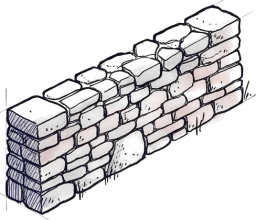
All over the slopes of Provence you walk past low walls of stacked stones with no binder at all. They hold up the soil of terraced crops, line the paths and divide the plots. Some are several centuries old.
A wall that breathes
A dry-stone wall’s strength lies in how it is built, not in any mortar. The builder sorts the stones, puts the largest at the base, staggers the joints as in a brick wall and every so often sets long stones that run through the wall to tie it together. The core is filled with smaller stones. Finally, the wall leans slightly backwards: this is the batter.
Because it is not watertight, the wall lets rainwater through instead of holding it back. Pressure does not build up behind it, which explains why it lasts so long. Its gaps also shelter lizards, insects and small plants.
Restanques and bories
In Provence, the farming terraces held up by these walls are called restanques. They made it possible to grow olives, vines, almonds and cereals on slopes too steep to plough.
Bories are huts built entirely of dry stone, roof included: the stones are laid in slight overhang, course after course, until they meet at the top. This technique is called corbelling. They served as shelters for shepherds, tool sheds or sheepfolds. Near Gordes, in the Luberon, a group of restored huts, the “village des Bories”, is open to visitors.
A recognised heritage
In 2018, the art of dry-stone walling was added to UNESCO’s Representative List of the Intangible Cultural Heritage of Humanity. The nomination was shared by eight countries: Croatia, Cyprus, France, Greece, Italy, Slovenia, Spain and Switzerland.
What is protected is not any particular wall but the know-how: choosing the stones, laying them, passing these skills on. Volunteer building workshops now let you try it, often in the mild months of spring and autumn.
Sources
- Art of dry stone walling, knowledge and techniques — UNESCO – Intangible Cultural Heritage
- Borie (cabane en pierre sèche) — Wikipedia (French)