True lavender and lavandin
Two plants, two altitudes, two scents. How to tell them apart, how they are distilled, and why Sault celebrates lavender on 15 August.
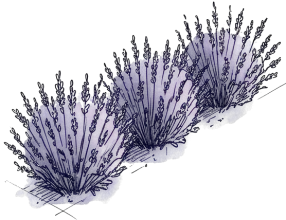
Not every purple field in Provence is “true” lavender. On the plateaus two plants are grown that look alike, but distillers never mix them up.
True lavender
True lavender, also called fine or English lavender (Lavandula angustifolia), grows wild on the dry, sunny slopes of the mountains of southern France. It likes altitude: it is grown on high plateaus such as Sault or the Albion plateau. Its tufts are small, its spikes short, and its scent soft and floral.
Its essential oil is rare and sought after. Oil produced in the defined areas of Haute-Provence carries a protected designation of origin (PDO), which governs where the plants come from and how they are distilled.
Lavandin
Lavandin is a natural hybrid of true lavender and spike lavender (Lavandula latifolia). It is sterile, so it is propagated from cuttings. Its tufts are bigger and rounder, its spikes longer, often with two side spikes on the stem. It grows much lower down and yields far more essential oil, with a more camphorous scent. It covers most of the big fields people photograph, notably on the Valensole plateau.
| True lavender | Lavandin | |
|---|---|---|
| Plant | wild species | sterile hybrid |
| Propagation | seed or cuttings | cuttings |
| Tuft | small, short spikes | large, long spikes |
| Scent | soft, floral | more camphorous |
| Oil yield | low | high |
Bloom, harvest and distilling
Depending on altitude and the year, flowering runs from mid-June to late July. The harvest follows in July and August. The cut stems are packed into the vat of a still, through which steam is passed. The steam carries the essential oil away; cooled in a coil, it turns back into liquid, and the oil, lighter than water, separates on the surface of the essencier. The scented water left behind is floral water, or hydrosol.
15 August in Sault
Sault, which readily calls itself lavender country, holds a lavender festival every year on 15 August, with a market, a parade and demonstrations of cutting with a sickle. By then the rows have often already been harvested: the festival celebrates the end of the season more than the bloom.
Sources
- Huile essentielle de lavande de Haute-Provence (appellation d'origine) — INAO – French National Institute of Origin and Quality
- Travaux sur la lavande et le lavandin — CRIEPPAM